|
Monthly Energy Update
October 31, 2014
Highlights
- Bearish
- Economic recession’s lingering impact
- Reduced OECD demand
- Increased U.S. production
- High crude oil storage levels
- Surplus capacity
- Bullish
- Uncertainty in the Middle East
- Weak dollar
- Improving economy
- Continuing geopolitical uncertainty
Middle East, Ukraine, Weather, and the Economy
The continuing political and commercial uncertainty in the Middle East and OPEC countries maintains upward pressure on oil prices. 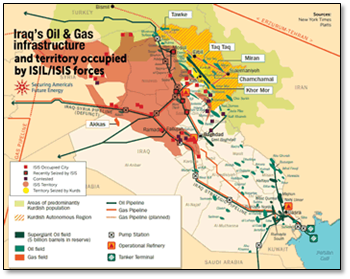 This is due both to fear and reduced oil exports. The renewed fighting in Iraq has been limited to northern areas which are not significant oil producers. Likewise, the Ukraine, Syria and Egypt, are not major oil producers and not OPEC members. However, there is concern that the turmoil in these countries could disrupt deliveries or spill over into neighboring countries and regions that do produce oil. First, the revolution in Egypt drove oil prices up, not because Egypt is a significant oil producer (they are a net importer) but because they control major shipping paths. After Egypt, revolution spread to Libya, which is an oil producer. Then, Iran began embargoing shipments to Europe while European countries embargo Iranian crude and political turmoil has risen again in Egypt. In addition, sectarian friction continues in Iraq, problems continue to plague Nigeria, and eastern Libya shut down their export terminals in a play for more of the county’s oil revenue. Then threats of U.S. intervention in Syria and Iraq add to the instability of the region. These factors, along with high prices, are fueling concerns about OPEC and Russian oil supplies and strengthening the drive to fully develop alternatives to OPEC crude. This is due both to fear and reduced oil exports. The renewed fighting in Iraq has been limited to northern areas which are not significant oil producers. Likewise, the Ukraine, Syria and Egypt, are not major oil producers and not OPEC members. However, there is concern that the turmoil in these countries could disrupt deliveries or spill over into neighboring countries and regions that do produce oil. First, the revolution in Egypt drove oil prices up, not because Egypt is a significant oil producer (they are a net importer) but because they control major shipping paths. After Egypt, revolution spread to Libya, which is an oil producer. Then, Iran began embargoing shipments to Europe while European countries embargo Iranian crude and political turmoil has risen again in Egypt. In addition, sectarian friction continues in Iraq, problems continue to plague Nigeria, and eastern Libya shut down their export terminals in a play for more of the county’s oil revenue. Then threats of U.S. intervention in Syria and Iraq add to the instability of the region. These factors, along with high prices, are fueling concerns about OPEC and Russian oil supplies and strengthening the drive to fully develop alternatives to OPEC crude.
The winter of 2013/14 was bitterly cold over much of the country. This put pressure on natural gas storage levels and pipeline capacity. The result was significant volatility and price spikes in the Northeast and Midwest. The cold of last winter also dramatically reduced natural gas storage levels and put upward pressure on heating fuel prices. Increased production has helped to refill storage and temper price pressure.
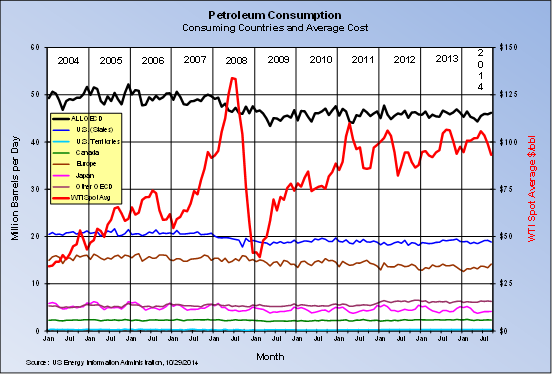
The chart below shows petroleum consumption for the OECD countries since 2004. These are the net petroleum consuming countries of the Organization for Economic Cooperation and Development. The chart illustrates that, until 2008, consumption in these countries had been relatively stable, at near 50 million barrels per day, despite climbing prices.
The record price levels during the summer of 2008, along with the worldwide recession, ended the stable consumption. Demand began a decline and consumption fell and has stabilized at about 45 million barrels per day. Petroleum consumption for the OECD countries is now about 10% lower than years prior to the recession.
New discoveries and drilling techniques have also had major impacts on the energy industry in recent years. The majority of new wells are now horizontal rather than vertical or directional. These wells are more expensive, but have far higher initial production than traditional wells and, with current high prices, they have become economically viable. As a result, onshore U.S. oil production in the lower 48 states has increased by more than 60% over the past three years and is now at a level last seen over twenty years ago.
Price Trends
Energy prices now appear to be driven primarily by the political upheaval in OPEC countries. This is offsetting the weak demand stemming from the continuing economic downturn. Other geopolitical tensions, surplus capacity, and a weak dollar are now secondary factors with their impact limited to minor variations within a relatively narrow range.
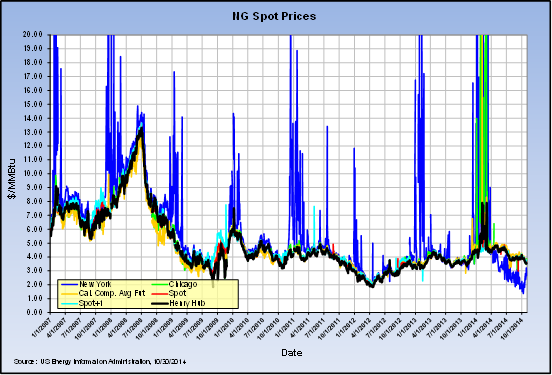
The exception to this has been blasts of severe winter weather in the Northeast. The cold snaps increased the demand for natural gas while disrupting some of its supply. This resulted in large, but brief, surges in spot prices for natural gas in New York.
In January of 2011, severe weather struck the eastern half of the country disrupting supply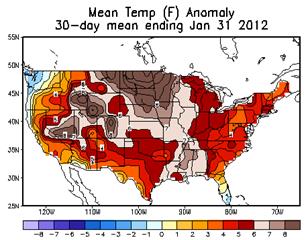 and drawing natural gas in storage down to average, but adequate levels. This put some upward pressure on natural gas prices. January of 2012, on the other hand, was unusually warm over the entire country. and drawing natural gas in storage down to average, but adequate levels. This put some upward pressure on natural gas prices. January of 2012, on the other hand, was unusually warm over the entire country.
The cold winter of 2010/11 was followed by an unusually hot summer over most of the country. This again caused a surge in air conditioning use with a corresponding demand for natural gas to fuel peaking power plants. However, with strong production, natural gas in storage remained near average levels and increased with a warmer than normal start of the injection season.
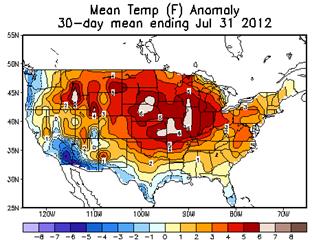 The summer of 2012 also brought unusually high temperatures over the center of the country. As before, this caused a surge in air conditioning use and a demand for natural gas to fuel peaking power plants. While this reduced the injections into storage, starting the season with the high storage numbers following the mild winter still resulted in very high storage levels as we ended the injection season. The summer of 2012 also brought unusually high temperatures over the center of the country. As before, this caused a surge in air conditioning use and a demand for natural gas to fuel peaking power plants. While this reduced the injections into storage, starting the season with the high storage numbers following the mild winter still resulted in very high storage levels as we ended the injection season.
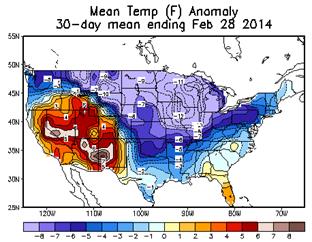
The winter of 2012/13 ended with natural gas in storage at average levels and crude stocks at new highs. This was followed by a moderate summer over most of the country and storage levels remained comfortable. However, the winter of 2013/14 saw bitter cold snaps over much of the country. This drew natural gas in storage down below five-year lows and crude stocks have come down to their historical five-year highs.
 Crude prices seem to have stabilized at a level above that necessary to encourage alternative energy production. However, if political tensions intensify, current storage levels and the use of alternatives might not be enough to stop crude price increases. Crude prices seem to have stabilized at a level above that necessary to encourage alternative energy production. However, if political tensions intensify, current storage levels and the use of alternatives might not be enough to stop crude price increases.
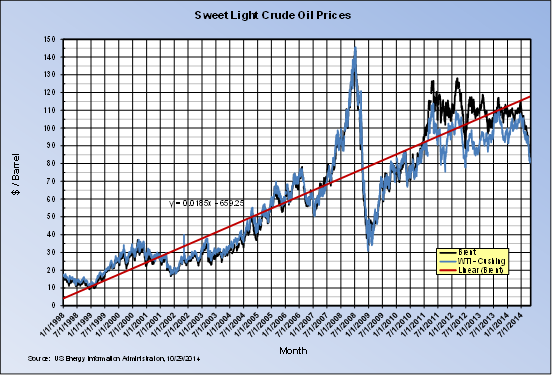
Historically, crude oil prices recover much more slowly than they collapse. However, the tensions in Libya and the Middle East drove crude prices up more quickly than expected. Time will tell whether the long term trend will follow the historical pattern. Over the past 15 years, the trend has been a fairly steady increase. When crude prices peaked in 2008, they aroused strong sentiment to develop alternative production techniques and fuels. If that sentiment can survive, alternatives might permanently displace some demand for OPEC crude and help stabilize crude prices at, or slightly below, current levels.
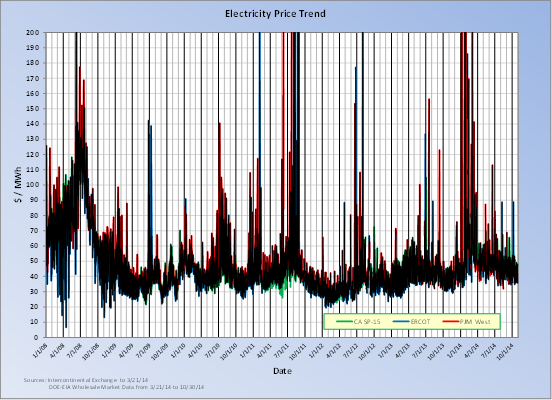
Since electricity prices are influenced much more by natural gas prices than by crude oil prices, electricity prices remained relatively stable compared to crude. However, in 2008 the high oil prices and weakening dollar pulled natural gas prices up and this caused electricity prices to climb as well. More recently, low gas prices allowed electricity prices to drop and stabilize.
The charts that follow illustrate the movement of the energy markets. The first chart clearly illustrates the dramatic spikes in New York natural gas prices when severe winter weather strikes the Northeast. The charts also illustrate the relatively low, level of current natural gas and electricity prices.
Since natural gas is the primary fuel used to meet variable electricity demand (base demand is typically met with coal, hydro, and nuclear), its cost is reflected in the price of electricity.
 |
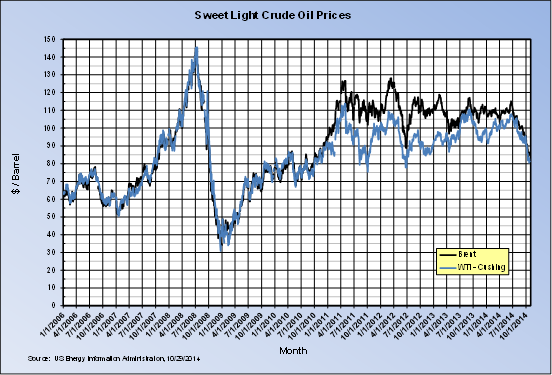
In 2006, a sense of increasing stability along with high production and storage levels started a steady decline in oil prices. The falling prices prompted OPEC production cuts which arrested the decline. This, along with the arrival of cold weather in February of 2007, and the other factors mentioned above, triggered steadily increasing crude oil prices, interrupted only by brief, and small, declines. Supply concerns, a weak dollar, little excess capacity, and speculation continued to drive crude oil prices to record highs until July of 2008, when they began a decline in response to falling demand and congressional scrutiny of index trading. In September of 2008 the hurricanes in the Gulf of Mexico caused oil prices to spike briefly, but their decline quickly resumed and prices fell to levels last seen five years earlier.
In an effort to arrest the decline in crude oil prices, OPEC announced a largely symbolic production cut at their emergency meeting in October of 2008. The 1.5 million barrel per day cut was less than the amount that demand had declined in the U.S. alone. In addition, even the revised quotas actually allowed increased production by some OPEC members (if they had the capacity). As a result, the announcement had no impact on prices.
In their December, 2008 meeting, OPEC followed with another quota reduction that became effective January 1, 2009. Again, the reduction only served to bring the quotas more in line with demand. Like the previous reduction, this one had no impact on prices. Crude oil prices have, however, recovered and, despite some recent declines, are still at levels that are higher than they were prior to the run up. Crude and natural gas prices are now decoupled and crude has recently been trading at over four times the cost of natural gas on a Btu basis.
Together, these charts illustrate the relationship between natural gas and crude oil prices and their impact on electricity costs. A number of factors, including those mentioned earlier, have contributed to these price trends. Other factors are examined in more detail below.
Production Trends
Historically, natural gas and crude oil prices have influenced each other and also tended to drive the price of electricity. For this reason, their production and inventories are important, not only in their own right, but also to understand and anticipate electricity price changes.
At the turn of the 21st century both natural gas in storage and crude oil stocks were at very low levels. This contributed to escalating prices. Higher prices encouraged exploration and production increases that brought inventories well above average levels. In September of 2004, Gulf of Mexico production shut-ins resulting from hurricane Ivan helped to quickly draw crude oil inventory levels below five-year lows. With the return of production, and steady imports, inventories were restored and stocks built to well above previous five-year highs. Then, in the aftermath of hurricanes Katrina and Rita, these stocks again were drawn down, but the mild winter of 2005/06 allowed them to rebuild quickly.
With strong inventories and quiet 2006 and 2007 hurricane seasons, the energy markets responded with some softening in natural gas and electricity prices. While hurricanes Gustav and Ike were certainly severe, they did not have nearly the impact on oil and gas production that hurricanes Katrina and Rita had in 2005. As a result, prices were not severely impacted.
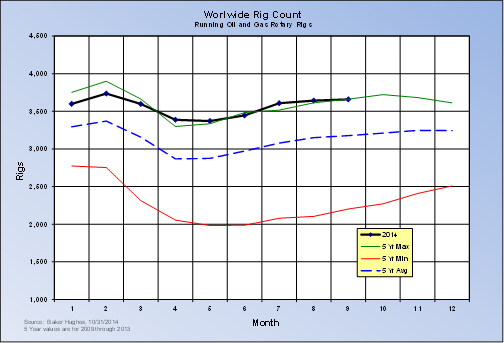
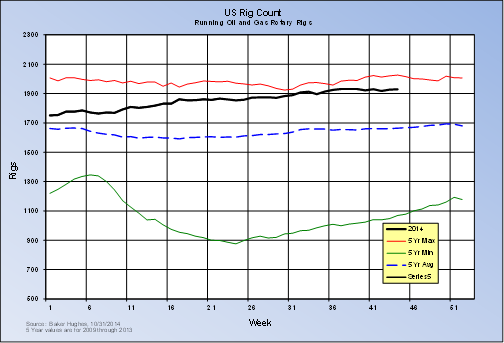
The following charts show that the number of oil and gas rigs in the U.S. and worldwide recovered from the huge impact that low prices had on them at the start of the recession in 2009. With the low prices, exploration and the number of running oil and gas rigs dropped below five-year minimums. Then, with oil prices back at high levels, the number of oil rigs climbed above the maximum number over the previous five years and, even with the current reduced demand, they remain high. In addition, most of the new wells are horizontal with much higher initial production than traditional vertical and directional wells.
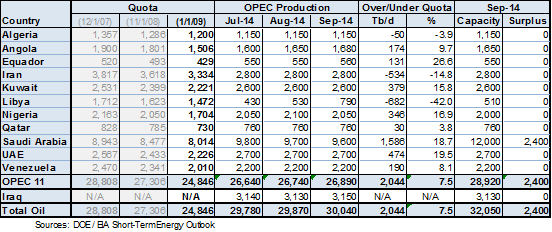
The following table illustrates the relative level of OPEC oil production by country.
OPEC Oil Production
(Thousands of Barrels per Day)
Only Saudi Arabia has sufficient surplus capacity to influence markets.
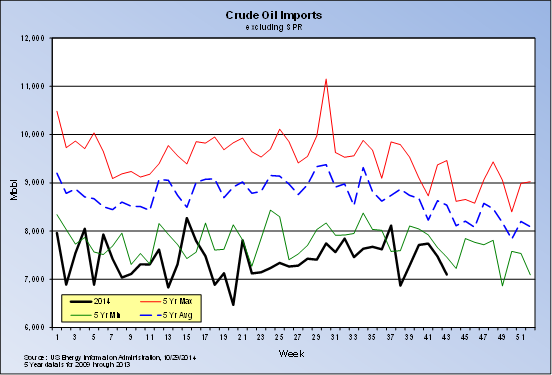
Crude oil imports have dropped to very low levels as prices have climbed, demand has remained low, and domestic production has increased.
Crude oil import levels are illustrated in the following chart.
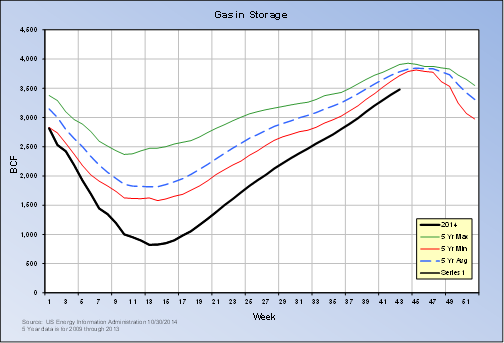
The bitter cold this past winter drew natural gas storage levels well below their previous five-year lows to levels last seen in 2001. While levels are rebuilding, without a significant production increase or drop in demand, it will be difficult to rebuild natural gas storage to average levels before winter.
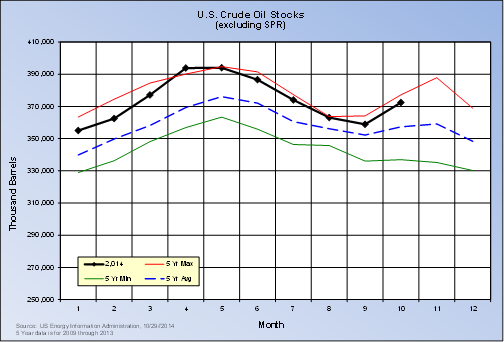
For a while, high crude oil prices caused a decline in stocks but, with continuing low demand and high domestic production, stocks rebuilt to five-year highs.
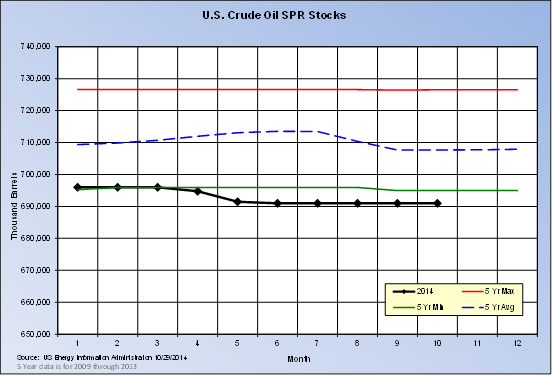
With a 5 million barrel release this spring, the 30 million barrel release in response to the disruptions in Libya, a 1 million barrel loan to Marathon Petroleum in the aftermath of hurricane Isaac, and the releases following the hurricanes of 2005, the U.S. strategic petroleum reserve is now below its 5-year minimum level.
Conclusions
Relatively low demand, surplus capacity, increasing domestic production, high crude oil storage levels, and signs of stabilization in the economy put downward pressure on prices. However, the continuing tensions in the Middle East and other OPEC countries are offsetting that pressure and prices could be pushed higher by a number of factors including:
- new supply disruptions,
- a strengthening global economy,
- increasing Third-World demand,
- reduced production by Saudi Arabia, Russia, Iraq, or other major producers.
If relative stability returns to the Middle East, and barring major supply disruptions in other regions, energy prices should stabilize near current levels or drop slightly as we enter the winter season.
|